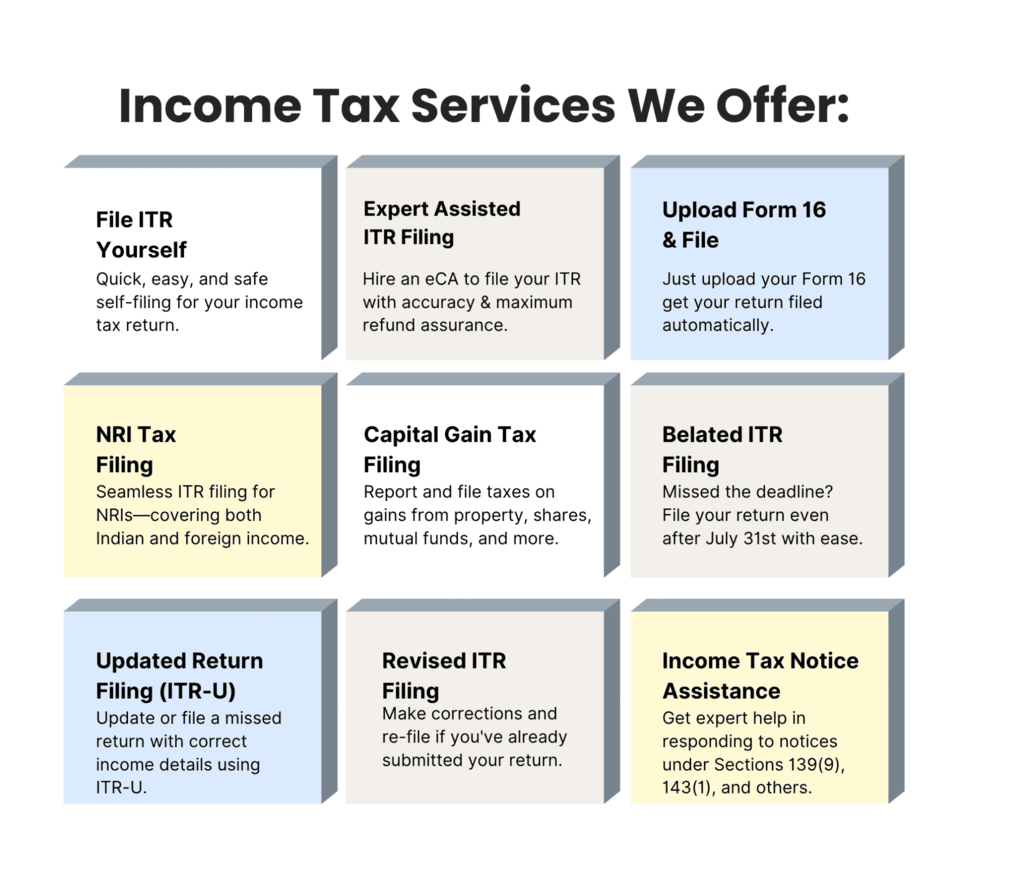


Income Tax Return (ITR)
Filing ITR (income tax return) is a crucial duty of every taxpayer in India, ensuring adherence to the nation's tax regulations. Income tax filing involves detailing all sources of income, deductions, and tax liabilities for a comprehensive report to the Income Tax Department. Early ITR e-filing helps avoid errors and last-minute technical glitches, ensuring a smoother submission process.
IndiaFilings simplifies the entire Income Tax e Filing process, making it quick, easy, and hassle-free. Our platform guides you step-by-step, from auto-fetching your pre-filled data to assisting you in choosing the right tax regime. Whether you're an individual or a business owner, our user-friendly ITR efiling system ensures your taxes are filed accurately and on time.
Experience a seamless ITR filing process online with IndiaFilings and say goodbye to tax season stress!
Who Needs to e File an ITR Income Tax Return?
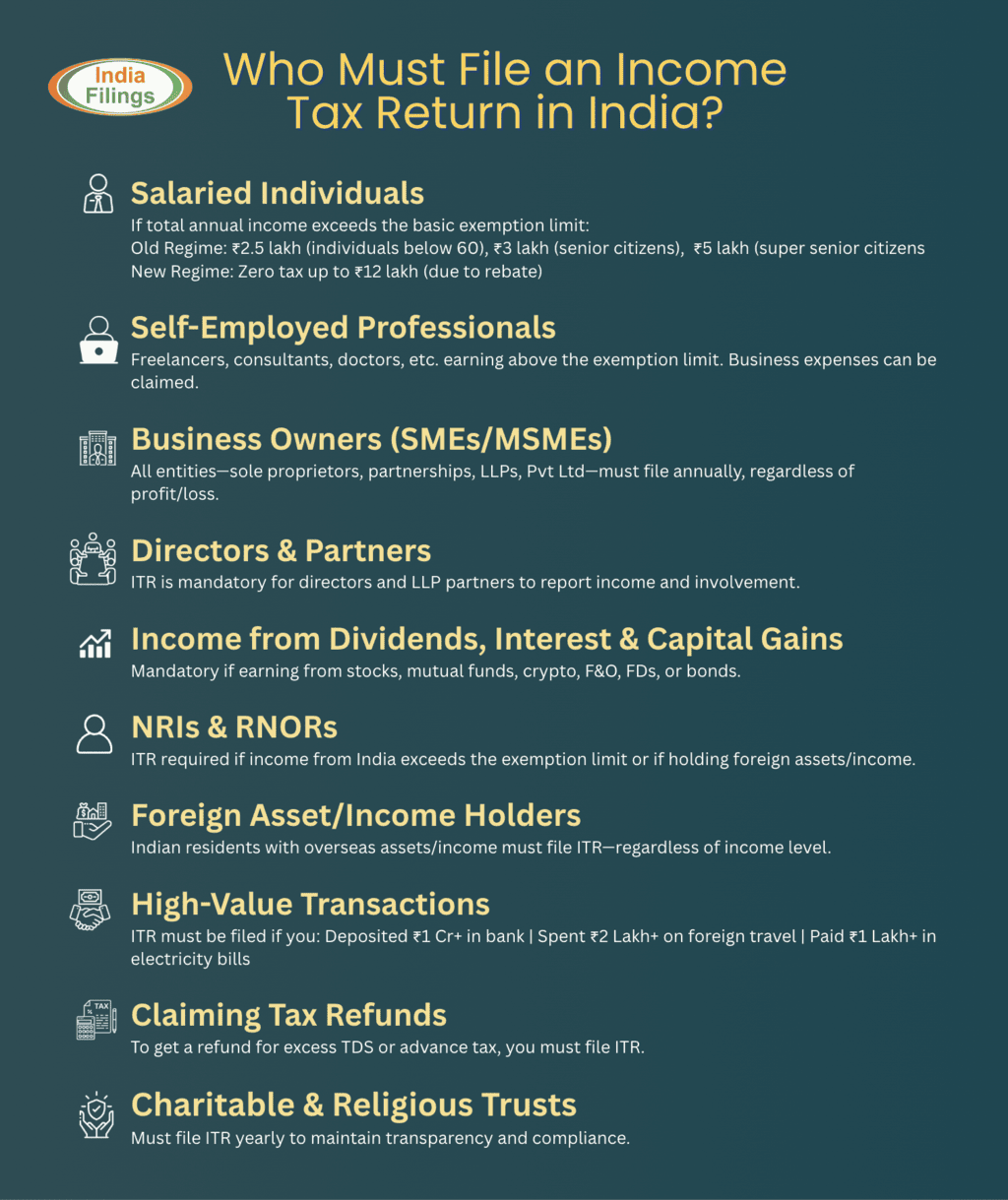
Income tax filing is not just a legal obligation, but also a financial responsibility. It applies to individuals and entities across various categories and income levels. Below is a clear overview of who must e-file their ITR income tax return in India:
- Salaried Individuals: If your total annual income exceeds the basic exemption limit, you are required to file IT returns online.
- Self-Employed Professionals: Freelancers, consultants, doctors, lawyers, designers, and other independent professionals with income above the exemption threshold must e-file. Business-related expenses can also be claimed as deductions.
- Business Owners (including SMEs & MSMEs): All business entities—including sole proprietorships, partnerships, LLPs, and private limited companies—must file IT returns online annually, irrespective of profit or loss.
- Directors and Partners: Individuals who serve as directors in private limited companies or partners in LLPs are mandated to file ITRs reflecting their share of income and financial involvement in the entity.
- Dividend, Interest, and Capital Gains Earners: If you receive income from dividends (mutual funds, equities, etc.), interest (from FDs, bonds, etc.), or capital gains (from stocks, crypto, F&O, mutual funds), it’s mandatory to report and pay applicable taxes through ITR.
- NRIs and RNORs: NRIs (Non-Resident Indians) with income arising in India exceeding the exemption limit must file IT returns online. RNORs (Resident Not Ordinarily Residents) with foreign income or assets may also be required to file based on disclosure obligations.
- Foreign Asset or Income Holders: Indian residents holding foreign assets (like overseas bank accounts, shares, or property) or earning foreign income are required to file ITR, even if their taxable income is below the exemption limit.
- High-Value Transaction Individuals: Even if your income is below the basic exemption limit, you must file ITR if you have deposited Rs. 1 crore or more in a bank account, spent over Rs. 2 lakh on foreign travel, or paid more than Rs. 1 lakh in electricity bills in a year.
- Claiming Tax Refunds: If you've paid excess tax (through TDS, advance tax, etc.), you must file an ITR to claim your tax refund.
- Charitable and Religious Trusts: Organisations that manage charity funds, religious institutions, or voluntary contributions must file ITRs annually to maintain financial transparency and tax compliance.
Eligibility for Income Tax efiling in India
In India, the obligation to do ITR online filing arises under certain conditions. Primarily, if your gross total income exceeds the basic exemption limits, you're required to e-file your return - and the limits vary based on your age and the tax regime chosen.
A tax regime refers to the structure under which your income is taxed. Taxpayers can opt for either the Old Tax Regime, which allows various deductions and exemptions, or the New Tax Regime, which offers reduced slab rates but restricts most deductions.
Old Tax Regime
The following criteria apply to the old tax regime:
- Individuals under 60 years: Rs 2.5 lakh
- Individuals between 60 and 80 years: Rs 3.0 lakh
- Individuals over 80 years: Rs 5.0 lakh
| Income range | Income Tax Slab Rates |
|---|---|
| Up to Rs. 2,50,000 | Nil |
| Rs. 2,50,001 to Rs. 5,00,000 | 5% |
| Rs. 5,00,001 to Rs. 10,00,000 | 20% |
| Above Rs. 10,00,000 | 30% |
New Tax Regime (Updated - Union Budget 2025)
| Income Range (Rs.) | Tax Rate (%) |
|---|---|
| Up to 4,00,000 | NIL |
| 4,00,001 - 8,00,000 | 5% |
| 8,00,001 - 12,00,000 | 10% |
| 12,00,001 - 16,00,000 | 15% |
| 16,00,001 - 20,00,000 | 20% |
| 20,00,001 - 24,00,000 | 25% |
| Above 24,00,000 | 30% |
Other circumstances that require filing ITR
Even if your income is below these thresholds, specific situations require you to file ITR. Key examples include:
- Deposited Rs 1 crore or more in one or more current bank accounts.
- Deposited Rs 50 lakh or more in one or more savings bank accounts.
- Spent over Rs 2 lakh on foreign travel.
- Incurred electricity expenses exceeding Rs 1 lakh during the financial year.
- Had TDS or TCS exceeding Rs 25,000 (or Rs 50,000 for senior citizens).
Business and Professional Income Thresholds
Businesses: Mandatory if your total sales, turnover, or gross receipts exceed Rs 60 lakh during the financial year.
Professionals: Mandatory if gross receipts exceed Rs 10 lakh during the financial year.
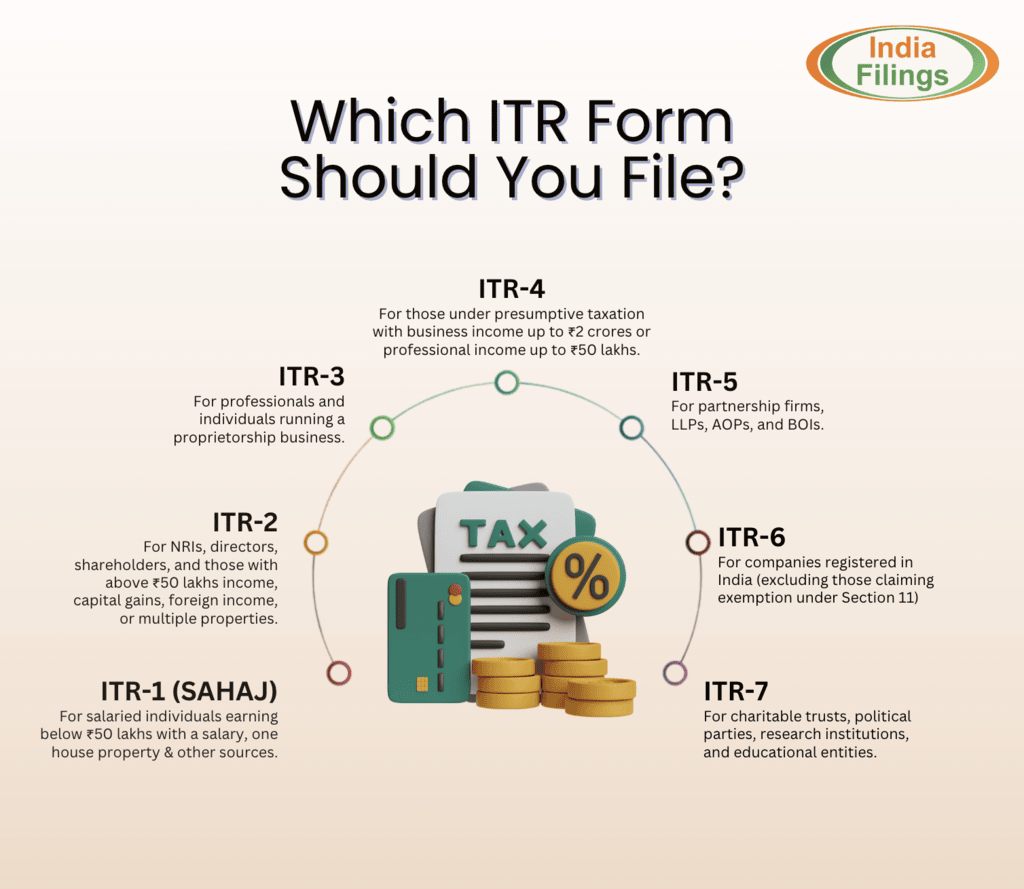
Income Tax Return Forms in India
The process of ITR e filing is streamlined through various Income Tax Return forms, each designed to cater to different types of taxpayers. Choose the form that matches your sources of income and taxpayer category (ITR-1 through ITR-7).
Due Date for ITR e Filing
Timely income tax efiling in India is mandatory to avoid penalties. Key due dates for the Financial Year (FY) 2024-25 are listed below:
- ITR Filing for Individuals and Entities Not Liable for Tax Audit: Original last date was July 31, 2025; extended to September 15, 2025 and further extended to September 16, 2025.
- ITR Filing for Taxpayers Under Tax Audit (excluding transfer pricing): Due by October 31, 2025.
- ITR Filing for Taxpayers Covered Under Transfer Pricing: Due by November 30, 2025.
- Last date for Revised/Belated Return of Income for FY 2024-25: December 31, 2025.
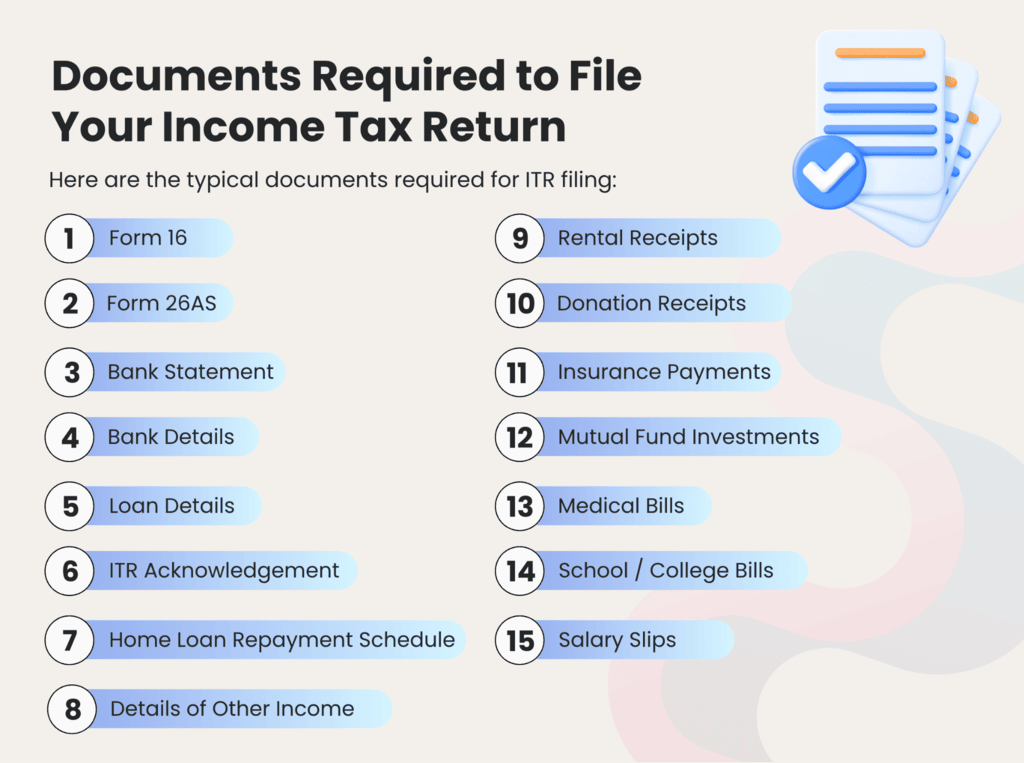
Documents Required for Income Tax e Filing
When preparing for your e Filing of Income Tax Return in India, it's important to have all necessary documents handy to ensure a smooth and accurate submission process.
General Documents for Income Tax Filing
- PAN (Permanent Account Number)
- Aadhaar (Linked to PAN)
- Bank Account Details
Income-Related Documents
- Salary Slips
- Rent Receipts (for HRA claims)
- Form 16 (Salary)
- Form-16A, Form-16B, Form-16C as applicable
- Form 26AS (Tax credit statement)
Deductions and exemptions-related documents
- Interest Certificates from banks/post offices
- Home Loan Details (interest certificate)
- Proof of Tax-Saving Instruments (PPF, NSC, ELSS, insurance, etc.)
- Income from Capital Gains: sale documents
- Rental Income: Lease agreements and rent receipts
- Foreign Income and Dividend Income Proofs
Procedure for eFiling of ITR in India
Income tax e filing in India can be accomplished through two primary methods: offline to online and entirely online. Below are step-by-step guides for both approaches.

eFiling ITR Offline to Online Method
- Download the Appropriate ITR Form from the official Income Tax Department website (Excel/ Java utilities available).
- Fill out the form offline on your computer.
- Save the form in XML format.
- Upload the XML file to the Income Tax e-Filing Portal and submit.
Income Tax eFiling in India Online
- Step 1: Log in to the Portal - Visit the Income Tax e-filing website and click "Login".
- Step 2: Enter Login Credentials - Use your PAN as username and your password to login.
- Step 3: Access E Filing Services - Go to "e-File" > "File Income Tax Return".
- Step 4: Choose the Assessment Year and Filing Mode - Select the assessment year (e.g., AY 2025-26) and choose Online mode.
- Step 5: Select Taxpayer Category - Choose Individual / HUF / Others.
- Step 6: Choose the Right ITR Form - Portal suggests the appropriate form based on provided data.
- Step 7: Reason for ITR Filing - Select reason for filing (regular, refund, revised, etc.).
- Step 8: Review and Edit Pre-Filled Information - Verify pre-filled information and correct if needed.
- Step 9: Review and Confirm ITR Return Details - Check income, deductions and tax liability.
- Step 10: Make Tax Payment - If tax is due, pay through the e-payment gateway and submit.
Completed Your ITR e-Filing? Here's What to Do Next
e-verify your return
After filing, e-verify your return to confirm authenticity. Methods include EVC generated via bank/Demat/mobile/email, Aadhaar OTP (mobile linked to Aadhaar), or by sending a signed ITR-V to CPC Bengaluru within 120 days.

Steps to Track e-Filing Status
- Visit the Income Tax e-Filing Portal and Login.
- Navigate to ‘e-File’ > ‘Income Tax Returns’ > ‘View Filed Returns’.
- View the status column for each filed return (e.g., "Successfully e-verified", "Processed", "Under Processing").
Revised Return Filings
If you discover an error or omission after filing an original or belated return (under Section 139(1) or 139(4)), you may file a Revised Return. Common reasons include missed deductions or incorrect disclosures. The deadline to file a revised return is December 31 of the relevant assessment year.
Belated Return Filings
If you miss the original deadline of 31st July, you can file a Belated Return under Section 139(4) on or before 31st December of the relevant assessment year. Penalties like Section 234F (Rs. 5,000 for income above Rs. 5 lakhs; Rs. 1,000 otherwise) and interest under Section 234A (1% per month) may apply.
Updated Return (ITR-U) Filing
If both original and belated deadlines are missed, you can file an Updated Return (ITR-U) under Section 139(8A) within four years from the end of the relevant assessment year (as per Budget 2025). Note: ITR-U cannot be used to claim refunds or reduce tax liability.